
Maximizing Tax‑Free Stipends for Travel Nurses in 2025
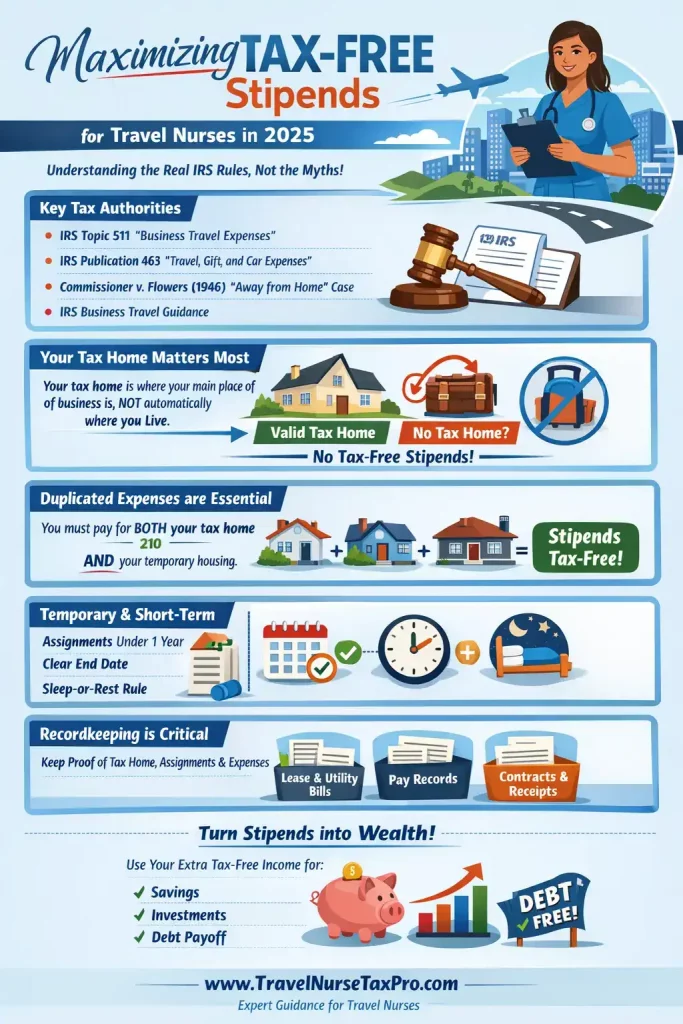
Tax‑free stipends are the single biggest tax advantage most travel nurses have. When they are structured correctly, they can keep large portions of your income out of federal and state taxable wages each year, which means more money for savings, debt payoff, and your future instead of the IRS. When they are not, they can turn into back taxes, penalties, and a level of stress you never planned on.
The important part is that the IRS did not rewrite the rulebook just because travel nursing exploded during and after the pandemic. The framework that governs tax‑free per diems today is built on decades of tax law, IRS guidance, and court decisions, and it still applies in 2025.
If you are serious about maximizing tax‑free stipends as a travel nurse in 2025, the opportunity comes from working inside those real rules, not the simplified myths circulating in Facebook groups or whispered at the nurses’ station. At Travel Nurse Tax Pro, the focus is to explain these rules in a straightforward, human, and practical way so you can use them confidently instead of worrying about them.
Your Tax Home, The Gatekeeper for Travel Nurse Stipends
Everything starts with your tax home. Not your mailing address, not where your driver’s license is issued, and not automatically your parents’ house. The IRS definition is narrower and less forgiving than most travel nurses expect.
Under Topic 511, your tax home is generally the entire city or general area where your main place of business or work is located. If you do not have a principal place of business, it may be your regular place of residence, but only if you actually maintain it while you are working away from it.
Why that matters so much
Tax‑free stipends are allowed only when you are working temporarily away from your tax home under Internal Revenue Code section 162 and related guidance.
No tax home means there is no “away from home”, so stipends are treated as taxable wages even if your agency labels them “per diem” or “tax‑free housing”.
The Supreme Court’s decision in Commissioner v. Flowers confirmed that travel expenses are deductible only when incurred “while away from home in the pursuit of business”, not just because you prefer to live somewhere else for personal reasons. If you do not maintain a qualifying tax home, the IRS may treat you as an itinerant worker, someone with no tax home, which means you are always “at home” wherever you work and cannot qualify for away‑from‑home benefits.
When that happens, stipends “fail” not because stipends are illegal, but because the underlying requirement, a valid tax home, was never met. That is why tax‑home analysis is always the first step before talking about maximizing anything.
Duplicated Living Expenses, The Backbone of Tax‑Free Stipends
The IRS does not allow tax‑free stipends just because you are far from home or on a travel contract. Distance alone does not create eligibility. What matters is whether you are duplicating living expenses.
Duplicating living expenses means you are
- paying to maintain your tax home, real ongoing living costs,
AND
- paying for lodging and meals near your assignment, at the same time.
Publication 463 explains that you must have living expenses at your main home that you duplicate because your work requires you to be away from that home. If you are not incurring meaningful ongoing expenses at your tax home, the IRS position is that you are not really duplicating anything.
For travel nurses, qualifying ongoing expenses often includes:
- rent or mortgage payments that continue while you are on assignment
- property taxes, homeowner’s dues, or insurance tied to your home base
- utility bills and similar fixed housing costs
- documented payments under a genuine rental arrangement, including with family, at fair‑market rates
What usually does not qualify?
- parking your belongings at a friend’s or parent’s house for free;
- “sending money home” occasionally with no lease, no clear obligation, and no real housing costs
Tax Court opinions have repeatedly deny travel and per diem deductions where a worker claims a tax home but cannot show consistent financial ties to that home, and travel nurses are evaluated under the same principles. This duplication rule is central and has not been relaxed for 2025.
Agencies may structure stipends using GSA per diem benchmarks, but those numbers are ceilings, not permission slips, if you do not meet the tax‑home and duplication tests, stipends within those ranges can still be fully taxable.
Temporary Assignments, the One‑Year Rule, the Sleep‑or‑Rest Test
Even if your tax home is solid and you are clearly duplicating expenses, your assignment must still be temporary to support tax‑free stipends.
Under IRS guidance in Topic 511 and Publication 463 an assignment is generally temporary if it is realistically expected to last, and does in fact last, one year or less at a single location if an assignment is realistically expected to exceed one year, it is considered indefinite from the moment that expectation exists, and the assignment location typically becomes your new tax home
Once an assignment becomes indefinite, stipends tied to that location become taxable going forward because you are no longer traveling away from your tax home, you are working in it. For travel nurses, this is where extensions and “just one more contract” in the same metro area often cause trouble.
The IRS also applies the sleep‑or‑rest rule. To be “away from home”, your work must require you to be away from the general area of your tax home long enough that you need sleep or rest to meet your job demands. That is why long daily commutes usually do not qualify, even if they are exhausting, and if you can reasonably return home after your shift without needing rest, you are typically not considered away from home.
There is no mileage number in the Code that automatically qualifies or disqualifies an assignment. Courts and the IRS apply a functional test, looking at the actual distance, time, and work demands to decide whether your assignment truly requires overnight rest.
Recordkeeping, The Proof Behind “Tax‑Free”
IRS rules are blunt on one point, if you cannot substantiate it, the IRS can treat it as if it never happened.Publication 463 lays out the substantiation standards that apply when you are claiming or defending travel expenses and per diem arrangements.
Even where per diems reduce the need for individual receipts, you still must be able to prove that you were eligible for tax‑free treatment in the first place. For travel nurses, that typically means maintaining records that show:
- where your tax home is
- that you maintained it financially while working away from it
- where and when your assignments occurred
- that each assignment was temporary, not indefinite and,
- that you duplicated living expenses
In practice, the strongest documentation looks like:
- lease agreements or mortgage statements, plus
- utilities or similar bills at your tax home
- bank, Venmo, or other payment records documenting ongoing housing costs
- assignment contracts, extension letters, and housing receipts at the assignment location
- mileage logs or travel calendars that support overnight travel and the sleep‑or‑rest requirement
What does not work well is trying to reconstruct all of this after an audit letter arrives. Courts routinely discount records created long after the fact without contemporaneous support.Publication 463 does not require perfection, but it does expect credible, consistent records created in real time. That’s why our Deduction Finder and Tax Organizer provides you the opportunity to contemporaneously document expenses. This helps the Pros, at Travel Nurse Tax Pro, maximize your deductions!
What Real Cases Show Travel Nurses About Risk
If you want to understand how these rules play out when travel nurse stipends are challenged, published court opinions are where the details surface.
Across multiple cases involving travel and per diem arrangements, judges have denied tax‑free treatment and travel deductions for the same recurring reasons:
- no credible tax home
- no real duplicated living expenses
- assignments that were effectively indefinite under the one‑year rule, and
- inconsistent or weak documentation
Cases involving itinerant workers are especially instructive. Courts have held that workers who go from job to job without maintaining a permanent residence generally do not qualify for away‑from‑home benefits, regardless of what their employer calls the payments, and travel nurses are evaluated using the same analysis.
This is one of the most common issues we see with clients who self-prepare a return and then win the IRS or State Audit Lottery!
Other decisions emphasize intent and pattern. If you work in the same metro area for a long stretch, often under a series of extensions or back‑to‑back contracts, a court may determine that metro area has become your tax home. If that happens, prior “tax‑free” stipends tied to that area can be reclassified as taxable wages retroactively.
This is why maximizing tax‑free stipends in 2025 is not about pushing the edge of the rules. It is about aligning your real facts, housing, assignments, and documentation, with a framework the IRS and courts have been using for decades. Agencies do not bear the ultimate tax risk, individual nurses do.
Turning Tax‑Free Stipends Into a Wealth Strategy
For travel nurses who genuinely qualify, tax‑free stipends are not just a technical tax break, they are a wealth‑building tool. When your stipends legitimately cover duplicated housing and meal costs, more of your taxable hourly pay can flow to savings, investments, and future goals instead of being consumed by rent and taxes.
That is where working with the right tax partner matters. A travel nurse‑focused tax professional, especially a firm like Travel Nurse Tax Pro that lives in this space every day, understands both the IRS rules and the realities of travel nurse life. The goal is to help you:
- confirm whether you truly have a defensible tax home
- design a contract and housing pattern that supports duplicated expenses
- monitor assignment length and extensions, so you do not quietly cross into “indefinite” territory
- build a documentation system that supports your tax‑free stipends if questions ever come up
Done right, maximizing legitimate tax‑free stipends is not about gaming the system. It is about putting the existing rules to work for you so your travel nurse career can fund the life you are building, not just the next assignment.
If you want a team that speaks travel nurse taxes fluently and cares about your long‑term wealth, not just this year’s return, visit www.travelnursetaxpro.com and connect with the Pros, not the ordinary Joes!